Most pump failures are not caused by the pump itself — they're caused by mismatched motors, poorly specified controllers, or incomplete PMC sets. Here's what you need to know before buying.
By SLEKA Engineering Team · November 7, 2026 · 11 min read
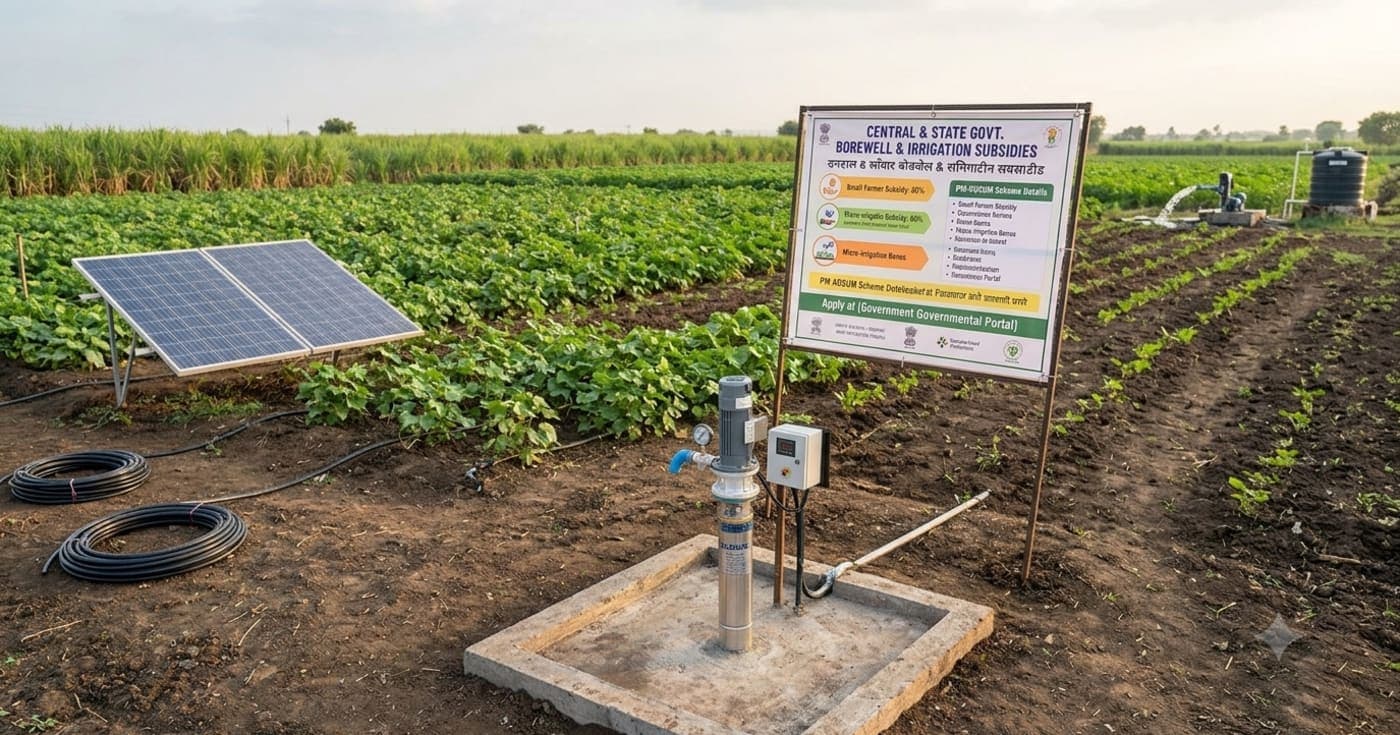
When a submersible pump system fails prematurely, the blame is almost always placed on the pump. But in the majority of field cases, the root cause lies elsewhere — in an undersized motor, a controller that couldn't handle voltage fluctuations, or a PMC set assembled from mismatched components. Understanding how these three elements work together is not optional knowledge for a serious buyer. It is the foundation of a system that runs reliably for ten or fifteen years without repeated intervention.
This guide is written for farmers, dealers, installers, and procurement managers who want to go beyond the horsepower rating and actually understand what they are buying. Whether you are commissioning a borewell installation in a dry-zone district or specifying equipment for an irrigation scheme, the information here will help you ask better questions, avoid expensive mistakes, and select a system that matches your actual operating conditions.
We have structured this post around the three core components — the submersible motor, the pump controller, and the PMC set as an integrated assembly — and then covered the most common selection errors buyers make in the field. If you want to explore SLEKA's range of submersible pump systems and motors, you can start at [our products page](https://slekaind.com/products).
A submersible motor is a hermetically sealed electric motor designed to operate while fully submerged in the water it is pumping. Unlike surface motors, it cannot rely on ambient air for cooling — instead, it is cooled by the flow of water passing over the motor casing as the pump operates. This is why adequate water flow around the motor body is a critical installation condition, not an optional one.
The motor sits below the pump in the borewell, connected directly to the pump impeller shaft through a mechanical coupling. When energised, the motor shaft rotates the impeller, generating the hydraulic pressure that lifts water to the surface. The closer the motor and pump are matched in terms of speed (RPM), shaft diameter, and coupling type, the more efficiently the system operates.
Buyers often focus only on horsepower, but there are several other specifications that determine whether a motor is right for a given installation:
Operating Voltage and Frequency: Submersible motors in India are rated for 415V three-phase or 230V single-phase supply at 50 Hz. Actual supply voltage in rural borewell sites frequently varies. A motor specified for tight voltage tolerances will trip or burn under sustained low-voltage conditions common in agricultural feeders.
Insulation Class: Standard submersible motors use Class B or Class F insulation. Class F provides a higher thermal tolerance and is preferable in high-cycle applications where the motor starts and stops frequently throughout the day.
Motor Casing Material: For aggressive groundwater conditions — high sand content, slightly saline water, or water with elevated mineral content — a stainless steel motor casing offers significantly longer service life compared to mild steel. SLEKA Industries manufactures its submersible motors in stainless steel precisely because the Indian groundwater environment across many regions is not chemically neutral.
Thrust Bearing Rating: The thrust bearing inside a submersible motor carries the axial load generated by the pump impeller. Under-rated thrust bearings are a primary cause of motor failure in high-head applications. Always confirm the thrust bearing rating against the actual operating head of the installation.
A pump controller is the electrical intelligence of the system. It sits at the surface — typically in a control panel near the power source — and manages how the motor starts, runs, and shuts down under various conditions. An adequate controller is not a luxury addition; it is the component that protects your motor investment from the electrical realities of field operation.
In the simplest configuration, a controller manages motor starting (either direct-on-line or star-delta) and provides basic overload protection. In more sophisticated systems, especially solar-powered installations, the controller performs dynamic MPPT tracking, manages dry-run protection, monitors phase balance, and communicates operating data.
DOL (Direct-On-Line) Starters: The most basic form of motor starting. Suitable for smaller motors (generally up to 5 HP) where the inrush current at startup is manageable. Low cost, simple to service, but offers limited protection.
Star-Delta Starters: Used for motors above 5 HP to reduce starting current. The motor starts in star configuration (lower voltage, lower torque) and transitions to delta once running speed is approached. Reduces starting stress on both the motor and the supply line.
Variable Frequency Drives (VFDs): The most advanced controller type for AC pump motors. A VFD allows the pump to be run at variable speeds, enabling precise flow control, soft starting, and significant energy savings under partial-load conditions. VFDs also provide comprehensive motor protection against phase loss, overvoltage, undervoltage, and overcurrent.
Solar Pump Controllers (MPPT-Based): For solar submersible pump systems, the controller must manage the DC output from the solar array and convert it to the correct AC supply for the motor — or, in DC pump systems, regulate DC directly. MPPT (Maximum Power Point Tracking) controllers continuously adjust the operating point of the solar array to extract maximum available power under changing light conditions. This is a critical function in any PM KUSUM-aligned solar installation.
If you are evaluating a solar pumping installation, SLEKA's [EPC and solar pumping resources](https://slekaind.com/epc-solar) provide additional context on system design.
The term PMC Set refers to the complete assembly of Pump, Motor, and Controller specified and supplied together as a matched unit. This is a critically important concept that is often misunderstood by buyers who purchase these components separately from different suppliers.
When components are sourced independently, the risk of mismatch increases substantially. A pump designed for a certain flow-head characteristic may be paired with a motor running at a slightly different RPM, reducing hydraulic efficiency. A controller specified for one motor's starting current may be inadequate for a different motor of nominally the same horsepower but different winding configuration. These mismatches do not always cause immediate failure — more often, they cause gradual performance degradation, increased energy consumption, and shortened component life.
A properly matched PMC set means the pump's performance curve (flow versus head) is optimised for the motor's speed and torque output. The controller's protection thresholds — overload current, undervoltage cutoff, dry-run delay — are calibrated for the specific motor being protected. The mechanical coupling between pump and motor is correctly specified. And the entire assembly has been tested together.
For government procurement — including state irrigation department tenders and PM KUSUM system procurement — specifying a complete PMC set from a single manufacturer is increasingly standard practice, because it establishes clear accountability. If the pump fails, the supplier cannot point to the motor supplier. If the motor fails, the supplier cannot point to the controller supplier. One vendor, one responsibility.
[SLEKA Industries](https://slekaind.com/) supplies complete PMC sets with matched pump, motor, and controller for both solar and grid-powered applications, which simplifies both procurement and after-sales service management.
Understanding the components is only half the challenge. The other half is avoiding the selection mistakes that are common even among experienced installers.
The most frequent error is selecting motor HP based on the pump's rated HP rather than the actual operating point. A pump operating in a high-head condition draws more power than the same pump at low head. If the motor is sized only to the nominal pump rating and the installation consistently operates near the high-head end of the pump curve, the motor runs continuously above its service factor — and fails earlier than expected.
Always size the motor based on the maximum power draw across the anticipated operating range, not just the pump's nameplate rating.
Submersible pump and motor assemblies must physically fit inside the borewell casing. The outside diameter of the motor is the limiting dimension. A 4-inch motor (nominal) is designed to fit in a 4.5-inch or 5-inch bore. A 6-inch motor requires a minimum 6.5-inch bore. Installing a motor that is too tight against the casing wall restricts the water flow around the motor body — which, as noted earlier, is the motor's cooling mechanism. Restricted cooling is a direct path to thermal failure.
In areas with known voltage fluctuation, a standard DOL or star-delta starter without under-voltage protection will allow the motor to run in conditions that gradually damage the windings. Before specifying any controller, collect actual supply voltage data at the installation site across different times of day, especially during peak agricultural demand periods when feeder voltage drops most severely.
As discussed above, this is the most consequential specification error. Saving a small amount by purchasing the pump from one supplier and the motor from another almost always costs more over the system's life in terms of efficiency losses, warranty disputes, and premature component replacement.
For dealers and installers looking to offer complete solutions to their customers, exploring SLEKA's [product range](https://slekaind.com/products) as a single-source PMC supplier is worth evaluating seriously.
Submersible pump systems are long-term infrastructure investments — they serve farms, communities, and commercial operations for decades when correctly specified. The pump itself is only one element. The motor that drives it, the controller that protects it, and the integrity of the PMC set as a matched assembly are equally important determinants of how the system will perform over its operational life.
If you are in the process of specifying or purchasing a submersible pump system — whether for a single borewell installation or a large-scale irrigation project — the starting point is always accurate site data: static water level, dynamic water level, required flow, required head, available power supply, and borewell casing diameter. With that data, the component selection becomes a straightforward engineering exercise rather than a guessing process.
SLEKA Industries builds submersible pumps, motors, and complete PMC sets in stainless steel for agricultural, municipal, and solar pumping applications. If you want to understand which configuration fits your specific installation, visit [slekaind.com](https://slekaind.com/) or reach out through our [contact page](https://slekaind.com/contact) to speak with our technical team.
---
Q1: Can I use any motor brand with a submersible pump, or does it have to be the same brand?
Technically, different-brand motors and pumps can be physically coupled if the shaft dimensions and RPM ratings match. However, from a system performance and warranty standpoint, using matched PMC components from a single manufacturer is strongly recommended. Mismatches in performance curves, thrust ratings, or coupling specifications are common when mixing brands, and warranty claims become difficult to resolve when multiple suppliers are involved.
Q2: What is the difference between a solar pump controller and a standard VFD?
A standard VFD accepts AC grid power as input and converts it to variable-frequency AC output to control motor speed. A solar pump controller (MPPT type) accepts DC input from a solar array, applies maximum power point tracking to optimise energy extraction, and then converts it to AC (or regulated DC) to drive the motor. Solar pump controllers are specifically designed for the variable-input-power environment of a photovoltaic system, which a standard VFD is not equipped to handle.
Q3: What does 'dry run protection' mean in a pump controller, and why does it matter?
Dry run protection is a controller feature that detects when the pump is operating without adequate water flow — typically because the borewell water level has dropped below the pump inlet. Running a submersible pump dry causes rapid impeller wear, motor overheating (because there is no water for cooling), and mechanical seal damage. A controller with dry run protection shuts the system down automatically under these conditions and prevents a temporary water shortage from becoming a costly equipment failure.
Q4: How do I know if my borewell can support a larger HP motor?
The primary constraint is borewell casing diameter, which determines the maximum motor outside diameter that can be installed. Beyond physical fit, you also need to verify that the borewell's sustained yield (gallons or litres per hour at dynamic conditions) is sufficient to supply the higher flow rate a larger pump will draw. Installing a pump that exceeds the borewell's yield will result in frequent dry-run conditions. A proper borewell yield test, conducted by a hydrogeologist or experienced driller, should precede any pump upsizing decision.
Q5: Is a PMC set from a single manufacturer always more expensive than sourcing components separately?
Not necessarily, and total cost of ownership almost always favours the matched PMC set. Separate sourcing may appear to save money at the point of purchase, but the risks of mismatch-related efficiency losses, voided warranties, and premature failures typically result in higher costs over the system's operational life. Additionally, single-source procurement simplifies spare parts management, service contracts, and accountability — all of which have real financial value over a ten-to-fifteen year installation life.
