Africa's solar irrigation market is expanding rapidly, and Indian manufacturers are uniquely positioned to capture it — here's your strategic entry guide.
By SLEKA Engineering Team · July 14, 2026 · 11 min read
Africa's solar irrigation boom is no longer a future forecast — it is an unfolding commercial reality reshaping agricultural infrastructure across sub-Saharan Africa, East Africa, and the Sahel region. With over 600 million smallholder and commercial farmers on the continent facing chronic water access challenges, and with solar technology costs falling by more than 80% over the past decade, the conditions for mass adoption of solar-powered water pumping systems have never been more favorable. International development finance institutions, including the African Development Bank and the World Bank's IDA arm, are actively channeling billions of dollars into rural electrification and food security programs that directly fund solar irrigation procurement.
For Indian pump and solar system manufacturers, this represents a generational export opportunity. India is already the world's largest producer of solar water pumps by volume, and its manufacturing ecosystem — combining cost-competitive production, a mature supplier base for motors, controllers, and panels, and decades of domestic deployment experience under programs like PM-KUSUM — gives Indian exporters a structural edge over European or Chinese competitors on the price-to-quality curve that African distributors and development project managers care most about.
This guide is written specifically for Indian manufacturers, trading houses, and export-focused OEMs who are evaluating or actively pursuing market entry into African solar irrigation channels. We will walk through market sizing, product specification requirements, certification pathways, distribution models, and logistics frameworks — so you can move from market interest to signed purchase orders with confidence. Companies like SLEKA Industries, which manufactures a full range of solar water pumping systems purpose-built for agricultural and off-grid applications, serve as an instructive example of the kind of product portfolio and technical documentation depth that African buyers and their procurement advisors expect.
The African solar irrigation market was valued at approximately USD 320 million in 2023 and is projected to exceed USD 900 million by 2030, growing at a compound annual growth rate of roughly 16%. This growth is concentrated in several high-priority corridors: the East African Community (Kenya, Tanzania, Uganda, Ethiopia), West Africa (Ghana, Nigeria, Senegal, Mali), and Southern Africa (Zambia, Zimbabwe, Mozambique). Each corridor has distinct demand characteristics shaped by crop types, water table depth, grid access levels, and the density of NGO and government program activity.
Three overlapping demand drivers sustain this market. First, climate pressure: rainfall unpredictability is accelerating farmer interest in controlled irrigation regardless of season. Second, program procurement: large-scale tenders from USAID Feed the Future, GIZ, FAO, and national agricultural ministries regularly specify solar pump systems for community and smallholder distribution at subsidized or grant-funded price points. Third, commercial horticulture: a rising class of commercial vegetable and flower farmers in Kenya, Ethiopia, and South Africa is purchasing solar irrigation systems on a purely commercial ROI basis, often through agricultural finance institutions. Indian exporters who can serve all three demand channels — tender supply, NGO procurement, and commercial dealer networks — will maximize their revenue footprint.
African solar irrigation buyers are not monolithic. Your route-to-market strategy must account for at least three distinct buyer types: (1) In-country distributors and agri-input dealers who resell to farmers and need competitive ex-works or CIF pricing, strong warranty terms, and localized after-sales support materials; (2) Project implementing organizations (PIOs) and NGOs who procure under donor-funded tenders requiring IEC certification, detailed technical datasheets, and references from comparable deployments; and (3) EPC contractors and system integrators who need technically configurable products, BOS compatibility documentation, and reliable lead times for project-scheduled deliveries.
The African market's dominant demand sits in the 0.5 HP to 5 HP surface and submersible solar pump range, with DC brushless motor systems preferred for reliability in areas with no grid-based repair infrastructure. Three-phase AC solar pumps driven by variable frequency drives (VFDs) or MPPT solar pump controllers are increasingly preferred for mid-to-large commercial deployments where head requirements exceed 30 meters. Exporters should be prepared to offer complete systems — solar panels, mounting structures, controller, pump, wiring harness, and a pre-engineered BOM — rather than pump units alone, since African distributors rarely have the technical assembly capacity that Indian domestic channel partners take for granted.
Africa's operating environments are demanding. Dust, humidity cycling, temperature extremes, and the near-total absence of manufacturer service networks mean that product reliability must be engineered in, not serviced out. Buyers and procurement advisors will scrutinize IP ratings (IP68 for submersible components is now a baseline expectation), motor winding insulation class, and corrosion resistance of pump bodies and shaft materials. Products designed for India's rural well and canal irrigation environments — such as the stainless steel and cast iron pump lines offered by manufacturers like SLEKA Industries — tend to translate well to African conditions, but exporters should be prepared to demonstrate this through field data and third-party test reports.
Tender-based procurement in Africa almost universally requires IEC 62253 compliance for solar pumping systems and often requests ISO 9001 quality management certification for the manufacturing facility. Some donor-funded projects additionally require CE marking or country-specific KEBS (Kenya Bureau of Standards) or SON (Standards Organisation of Nigeria) approvals. Indian exporters who have not yet mapped their certification portfolio against African tender requirements should treat this as a first-priority action item — certification gaps are the single most common reason Indian suppliers are disqualified from otherwise winnable tenders.
For most Indian manufacturers entering African solar irrigation markets for the first time, the in-country exclusive or semi-exclusive distributor model offers the lowest risk path. A well-chosen distributor provides local warehousing, customs clearance relationships, last-mile logistics capability, technical installation support, and existing customer relationships. The trade-off is margin compression and reduced control over end-customer pricing and brand positioning. Direct export to PIOs and NGOs via competitive tender is viable alongside a distributor relationship and can be structured as a carve-out in your distribution agreement.
Distributor selection is the highest-leverage decision you will make in your Africa market-entry process. Key evaluation criteria include: existing product portfolio complementarity (do they already sell agri-inputs, irrigation equipment, or solar products?), financial capacity to carry inventory, technical team capability for installation and commissioning, and network reach into target agricultural regions. Request references from current supplier partners and verify payment track records before committing to exclusivity. Payment terms of 30% advance with balance against bill of lading are standard for first orders; established relationships may migrate toward LC or open account terms over time.
African solar irrigation buyers are price-sensitive but not price-dominated — they will pay a premium for reliability and documented performance. A 1 HP DC submersible solar pump system (pump, controller, and 1kWp panel array) that sells at approximately USD 350–450 ex-works India can support a landed CIF East Africa cost of USD 420–520 and a distributor selling price of USD 600–750, which remains competitive against Chinese alternatives when paired with stronger warranty terms and local technical support. Exporters should build pricing matrices across HP ranges and system configurations to enable distributors to quote quickly and accurately.
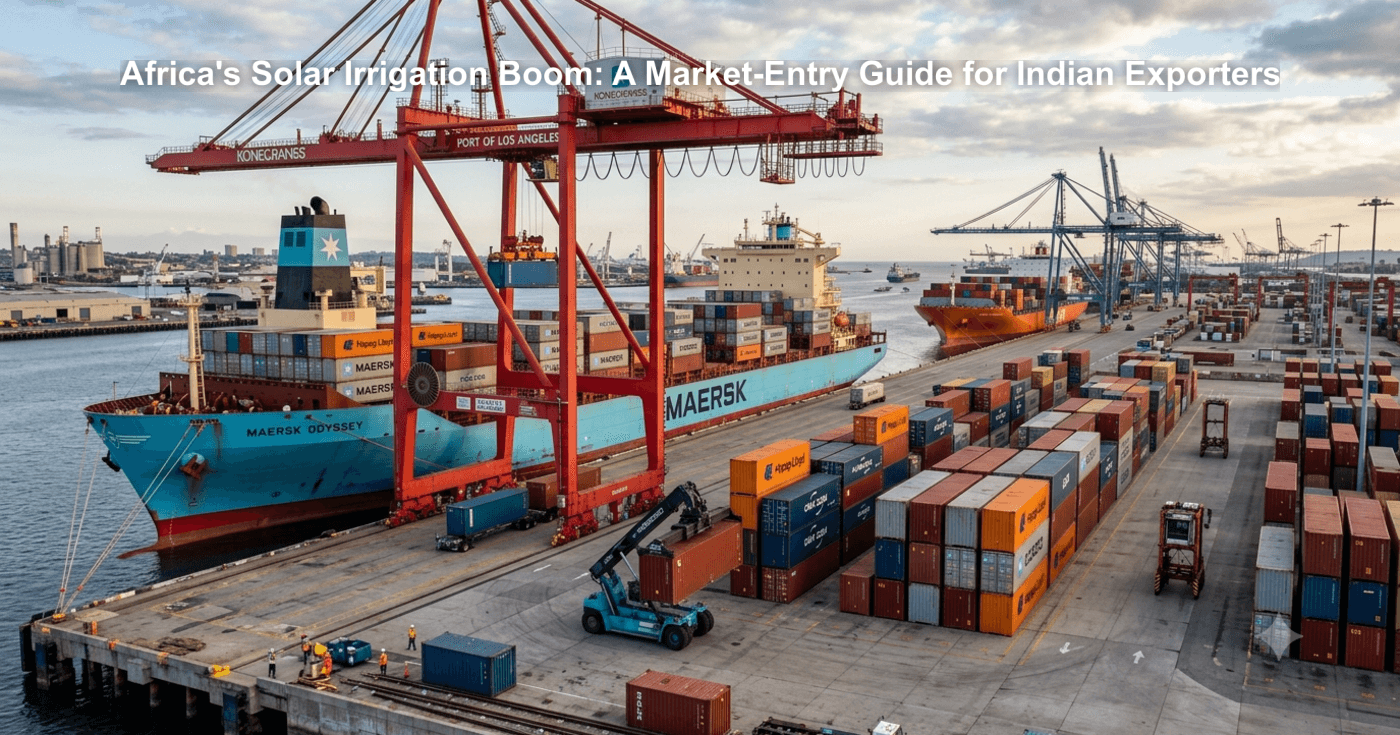
The primary shipping corridors from Indian west coast ports (Mundra, Nhava Sheva) to East African ports (Mombasa, Dar es Salaam) offer transit times of 14–21 days, making them suitable for both distributor stock replenishment and project-schedule deliveries. West Africa (Lagos, Tema, Dakar) involves 22–30 days from the same origin ports. LCL (less than container load) consolidation services are available for smaller orders but add 5–7 days and coordination complexity; FCL (full container load) is preferred for distributor stocking orders above approximately USD 40,000 in value.
Export credit insurance through ECGC (Export Credit Guarantee Corporation of India) is strongly recommended for all African market shipments, particularly for new distributor relationships. Irrevocable letters of credit confirmed through a reputable Indian bank remain the gold standard for large orders. For repeat buyers with strong payment history, documentary collections (D/P terms) offer a workable middle ground. Indian exporters should also explore the RBI's Export Promotion Capital Goods scheme and EXIM Bank's buyer's credit lines, which can make Indian equipment more competitively financed for African buyers.
In markets where technical service infrastructure is thin and equipment downtime directly translates to crop loss, after-sales support is not a differentiator — it is a threshold requirement. Indian exporters who invest in distributor technical training, multilingual (English, French, Swahili, Hausa) installation and troubleshooting manuals, and remote diagnostic support capabilities will earn the repeat purchase loyalty that eventually justifies premium pricing. Manufacturers like SLEKA Industries that invest in comprehensive product documentation and dealer support frameworks are increasingly recognized by African procurement professionals as preferred supply partners precisely because of this after-sales reliability.
A minimum 2-year product warranty with clear in-country spare parts availability is now a baseline expectation for serious African distribution partners. Structure your distributor agreements to include a mandatory spare parts initial order of 5–10% of total system order value, and provide a recommended spare parts list by SKU. Common failure points in solar pump systems — motor windings, seal kits, impellers, and MPPT controller boards — should be stocked at distributor level. A regionalized spare parts hub, potentially in Nairobi or Accra, can serve multiple country distributors and dramatically reduce warranty claim resolution time.
Africa's solar irrigation boom is accelerating, and the window for Indian exporters to establish first-mover distributor relationships and tender track records is open — but not indefinitely. Chinese competitors are investing heavily in African agricultural solar markets, and European suppliers continue to capture the high-value donor-funded segment on the strength of brand recognition and certification portfolios. Indian manufacturers who move now with the right products, the right certifications, and the right distribution partnerships can establish durable market positions that compound in value over the decade ahead.
Whether you are a manufacturer building your first export strategy or a trading house looking to add a high-growth product category to your Africa portfolio, the fundamentals are clear: strong product-market fit, rigorous certification compliance, a carefully selected distribution partner, and an unwavering commitment to after-sales support are the four pillars of successful Africa market entry in solar irrigation.
To explore export partnership opportunities and review the full solar water pumping product range, visit **[slekaind.com](https://slekaind.com)** today.
---
**Q1: What HP range of solar pumps has the highest demand in African agricultural markets?**
The 1 HP to 3 HP range dominates smallholder and community irrigation demand across East and West Africa. Commercial horticulture operations increasingly require 5 HP to 10 HP systems, especially for drip irrigation networks covering more than 2 hectares.
**Q2: Do Indian solar pump manufacturers need CE certification to export to Africa?**
CE marking is not universally mandatory across Africa, but it is frequently required in donor-funded tender specifications and by buyers sourcing for projects financed by European development agencies. IEC 62253 compliance and ISO 9001 certification are more consistently required across African markets and should be the primary certification priorities for Indian exporters.
**Q3: What are typical payment terms for first-time African distribution agreements?**
First-order payment terms of 30% advance with the balance payable against bill of lading copy are standard. Letters of credit confirmed through an Indian bank are the most secure instrument for larger orders. Export credit insurance via ECGC is strongly recommended regardless of payment terms chosen.
**Q4: How do I identify and evaluate potential solar irrigation distributors in Africa?**
Start with country-level agribusiness associations, trade fair participation (e.g., Nairobi's AgriBusiness Kenya or Accra's Ghana Agri-Expo), and referrals from Indian trade missions in target countries. Evaluate candidates on financial capacity, existing product portfolio, technical team strength, and geographic coverage within the target country. Conduct reference checks with current supplier partners before committing to exclusivity terms.
**Q5: How long does shipping from India to East Africa typically take, and what does it cost?**
Shipping from Mundra or Nhava Sheva to Mombasa or Dar es Salaam typically takes 14–21 days transit time. FCL freight rates for a 20-foot container range from approximately USD 800–1,400 depending on season and carrier availability. LCL rates are available for smaller shipments but add consolidation time and complexity. Always account for destination port handling, customs clearance, and inland haulage in your landed cost calculations.