Solar pump controllers are quietly becoming the backbone of modern agricultural irrigation in India — here is what every farmer, installer, and dealer needs to understand about how they work and why they matter.
By SLEKA Engineering Team · November 14, 2026 · 12 min read
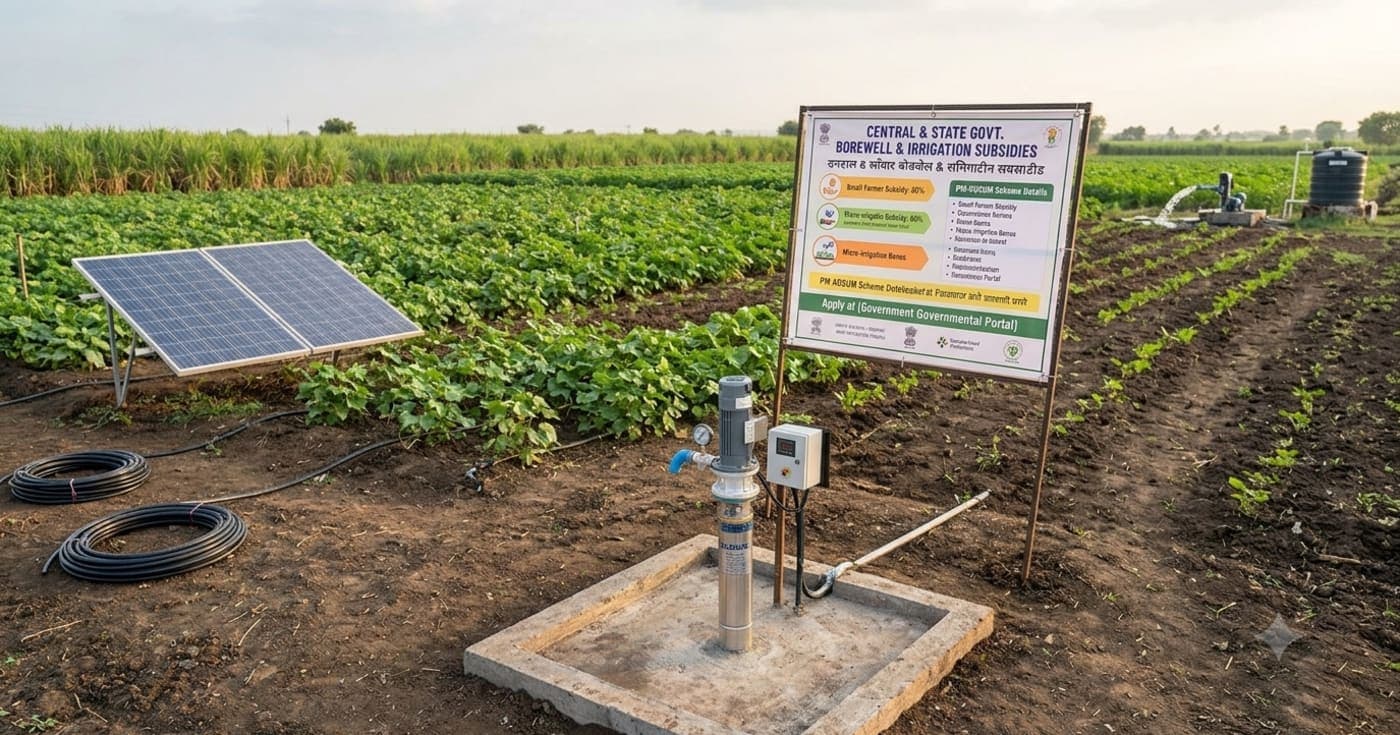
Across India's agricultural heartland — from the black cotton fields of Vidarbha to the alluvial plains of Punjab and the semi-arid zones of Rajasthan — one challenge repeats itself with stubborn consistency: getting water to the crop at the right time, with the right pressure, without destroying the farm's economics in the process. For decades, diesel pumps filled this gap, but at a cost that most smallholders could not sustain. Grid electricity arrived in many villages, but erratic supply, low voltage, and high per-unit charges created a different set of problems.
Solar-powered pumping changed the conversation. But the solar panel alone is not what makes a solar pump system intelligent, reliable, and long-lasting. That role belongs to the solar pump controller — a component that most buyers ask little about, yet one that determines whether the entire system performs as expected over ten, fifteen, or twenty years of field operation.
This article is for farmers evaluating solar irrigation for the first time, for dealers and installers who want to explain the technology confidently, and for state government procurement teams building specifications for PM KUSUM tenders. By the end, you will understand what a solar pump controller actually does, how the technology has evolved, what separates a capable controller from a mediocre one, and why the controller decision deserves as much attention as the pump or the panel array.
---
A solar pump controller — also called a solar pump drive, solar VFD (variable frequency drive), or MPPT pump controller — sits between the solar panel array and the submersible or surface pump motor. Its job sounds simple: convert the DC electricity produced by the panels into a form that the AC or DC motor can use. In practice, it is doing something far more sophisticated.
Solar irradiance is not constant. It changes by the hour, by season, by cloud cover, and by dust accumulation on panels. Without a controller, a pump motor connected directly to panels would run erratically, stall under low light, draw excessive current during peak irradiance, and suffer premature winding failure. The controller prevents all of this.
Most quality solar pump controllers incorporate Maximum Power Point Tracking (MPPT) algorithms. The solar panel's output voltage and current relationship follows a curve, and the point of maximum power on that curve shifts continuously with temperature and irradiance. MPPT circuitry samples this curve many times per second and adjusts the controller's input impedance to always draw from the panel at its peak efficiency point.
In practical terms, this means that even on partially cloudy days, or during the lower-irradiance hours of early morning and late afternoon, the pump continues to run — at reduced speed, but running. A system without MPPT would simply cut off, wasting hours of potential irrigation time.
For AC submersible motors — the most common type used with borewell installations across India — the controller must also vary the frequency of the output AC power to control motor speed. This is the VFD function. By ramping motor speed gradually at startup instead of applying full voltage instantly, the controller eliminates the high inrush current that would otherwise stress the motor windings and the pump shaft coupling on every start cycle.
This soft-start capability is not a luxury feature. In deep borewell applications where the motor may start and stop multiple times daily as cloud cover varies, the mechanical and electrical stress of hard starts accumulates rapidly. Controllers with proper VFD functionality extend motor life measurably in real field conditions.
---
The shift from diesel and grid-powered irrigation to solar-controlled pumping systems is not simply a fuel-substitution story. The intelligence embedded in modern solar pump controllers is enabling new patterns of water use that were not possible before.
One of the most damaging events in borewell irrigation is running a submersible pump after the water level in the borewell has dropped below the pump inlet. Without water to cool the motor and lubricate the mechanical seal, motor damage can occur within minutes. Quality solar pump controllers incorporate dry-run detection — typically through current sensing or pressure sensing — and automatically shut the pump down when the condition is detected, then attempt a restart after a configurable delay.
This single feature has prevented a significant proportion of field motor failures in irrigation deployments, particularly in hard-rock aquifer zones where borewell yield drops sharply during peak summer months.
Newer-generation controllers increasingly offer GSM or IoT-based communication modules, allowing farmers or pump operators to monitor system status, receive fault alerts, and even control pump operation from a smartphone. For large farm operations, government-managed irrigation schemes, or multi-pump solar installations under PM KUSUM Component-C, this remote visibility has practical value.
It also simplifies maintenance management. A technician can diagnose a fault alert remotely before travelling to site, arriving with the right replacement part rather than making a diagnostic visit followed by a parts-sourcing trip — a meaningful efficiency gain in rural field service.
India's borewell geology is highly variable. Static water levels range from under 20 feet in coastal alluvial zones to over 500 feet in hard-rock Deccan terrain. Panel configurations vary based on available roof or land area and the subsidy framework under which the system is installed. A good solar pump controller must accommodate this variability — handling a wide input DC voltage range, supporting both 3-phase and single-phase motors, and working with panel arrays of different wattages and configurations.
The controller's input voltage window is a specification that dealers and installers should examine carefully during product selection. A narrow input window that cannot handle the full voltage range produced by the panel array across seasons will cause system inefficiency or fault conditions.
---
The PM KUSUM scheme — Pradhan Mantri Kisan Urja Suraksha evam Utthaan Mahabhiyan — has dramatically accelerated solar pump adoption across India by providing substantial central and state subsidies for farmer-owned solar pumping systems. Under the scheme's Component-B, individual farmers can receive subsidy support for standalone solar pumps of up to specified horsepower ratings.
For a solar pump system to qualify under PM KUSUM, the entire system — including the controller — must meet specifications laid down by MNRE and the respective State Nodal Agencies. BIS certification for the submersible pump and motor, along with performance standards for the solar pump controller, are part of the compliance framework. Farmers and dealers sourcing systems for PM KUSUM applications must verify that the controller supplied meets these standards, as non-compliant components can result in subsidy disqualification during inspection.
Before purchasing a solar pump controller for a PM KUSUM-linked installation, verify the following with your supplier:
- Input voltage range: Confirm it matches your panel array's open-circuit voltage under local temperature conditions.
- Motor compatibility: Confirm 3-phase or single-phase output as required by your selected motor.
- Protection features: Dry-run protection, over-voltage, under-voltage, over-current, and over-temperature protections should all be present and documented.
- Warranty terms: Understand what the warranty covers and how the supplier handles field replacements in rural locations.
- BIS and MNRE compliance documentation: Ask for this specifically if the system is part of a subsidy application.
[SLEKA Industries](https://slekaind.com/) manufactures solar pumping systems — including submersible pumps, motors, and controllers — designed around the operational realities of Indian borewell conditions and PM KUSUM compliance requirements. Their [product range](https://slekaind.com/products) covers the configurations most commonly specified in state-level solar irrigation tenders.
---
Understanding failure modes helps buyers evaluate controller quality more rigorously than simply comparing feature lists.
Electrolytic capacitors inside the controller's DC bus degrade faster at elevated temperatures. In field enclosures exposed to direct sun in Rajasthan or Telangana summers, internal controller temperatures can reach levels that halve capacitor lifespan. Quality controllers use industrial-grade capacitors rated for extended temperature ranges, and their enclosures are designed with thermal management in mind — either through passive heat sinking or by ensuring the mounting specification keeps the controller shaded.
The switching transistors (typically IGBTs) that form the controller's output stage are driven by gate driver circuits. Poor gate drive design leads to incomplete switching transitions, which generate heat in the IGBT and can cause eventual failure. This failure mode is common in low-cost controllers that use inadequate gate drive voltage margins. It typically appears as a gradual performance decline followed by an over-temperature fault, making it difficult to diagnose without electronic testing equipment.
Dry-run protection that relies on current sensing can produce false positives if the current sensing circuit drifts with temperature or age — causing the pump to shut down unnecessarily during low-irradiance operation when motor current is legitimately reduced. Better-designed controllers use multiple sensing inputs or adaptive thresholds to reduce nuisance trips.
For dealers and installers, understanding these failure modes allows more productive conversations with suppliers about component quality and design choices — conversations that go beyond datasheet comparison.
---
Given the range of controllers available in the Indian market — from imported units to domestically manufactured options at various quality levels — the selection process can feel overwhelming. The following framework helps structure the decision.
Step 1 — Define your motor and panel specifications first. The controller must match the motor's rated voltage, phase, and horsepower. The panel array's maximum open-circuit voltage must fall within the controller's input range. These are hard constraints that eliminate many options immediately.
Step 2 — Assess the protection feature set against your field conditions. If your borewell is in a hard-rock zone with variable yield, dry-run protection is non-negotiable. If the installation is in a lightning-prone region, surge protection specifications matter.
Step 3 — Evaluate the supplier's service network. A controller with excellent specifications from a supplier who has no service presence in your district is a risk. For agricultural applications where crop cycles cannot pause for extended equipment downtime, local service availability is a real selection criterion.
Step 4 — Check subsidy compliance documentation proactively. Do not assume compliance — verify it with documentation.
Step 5 — Ask about field reference installations. A supplier who can point you to operating installations of similar scale in similar field conditions provides far more confidence than one who can only offer specification sheets.
[SLEKA](https://slekaind.com/) supports dealers and installers through its network and provides technical documentation relevant to PM KUSUM applications. Dealers and system integrators interested in partnerships can explore the [EPC and Solar](https://slekaind.com/epc-solar) section of the SLEKA website for more information on how the company supports project-scale solar pump deployments.
---
Solar pump controllers are not an afterthought in agricultural water management — they are the intelligence layer that determines whether a solar irrigation investment performs reliably across years of field operation or becomes a source of ongoing frustration. As India accelerates its transition to solar-powered irrigation under PM KUSUM and broader rural electrification goals, the quality and capability of the controller selected will increasingly separate systems that deliver genuine agronomic and economic value from those that look attractive on paper but underperform in the field.
Farmers, dealers, installers, and government procurement teams all benefit from understanding this technology more deeply — not to become electronics engineers, but to ask better questions, write better specifications, and make better purchasing decisions. If you are evaluating solar pump systems for a borewell application or a larger irrigation project and want to understand what SLEKA Industries offers in this space, [visit slekaind.com](https://slekaind.com/) or [reach out through the contact page](https://slekaind.com/contact) to speak with a technical representative.
---
Q1: What is the difference between a solar pump controller and a regular VFD?
A standard VFD is designed to work with a stable AC grid input and control motor speed by varying output frequency. A solar pump controller combines VFD functionality with a DC input stage, MPPT algorithms to harvest maximum power from panels, and protection logic specifically designed for solar-powered pump operation — including dry-run protection and solar-specific fault handling. They are not interchangeable for solar applications.
Q2: Can a solar pump controller work with any submersible motor?
Not automatically. The controller must be matched to the motor's voltage rating, phase (single or 3-phase), and power rating. Using a mismatched controller can result in motor damage or system inefficiency. Always confirm compatibility with the motor manufacturer's specifications before selection.
Q3: Does the solar pump controller need to be replaced more often than the pump motor?
Electronic components in controllers — particularly capacitors and switching devices — have finite lifespans that depend heavily on operating temperature and environmental conditions. With quality components and proper installation (including shading the controller enclosure from direct sun), a well-designed controller should provide many years of reliable service. However, controllers are generally considered a more maintenance-sensitive component than the motor itself, and system designs should account for eventual controller servicing or replacement.
Q4: Is a solar pump controller necessary if I am only using DC submersible pumps?
DC submersible pumps can in some cases be connected more directly to panels, but even DC pump systems benefit significantly from MPPT controllers that ensure the pump operates at optimal power across varying irradiance conditions. Without a controller, DC pump performance during low-light hours is substantially reduced, and motor protection features are absent.
Q5: How does PM KUSUM affect which controller I should buy?
PM KUSUM has technical specifications for solar pump systems — including controller requirements — set by MNRE and administered by State Nodal Agencies. For subsidy applications, the entire system must meet these specifications. Buyers should obtain explicit compliance confirmation and documentation from their supplier, as inspection at the time of subsidy disbursement will evaluate the installed system against the approved specifications.
