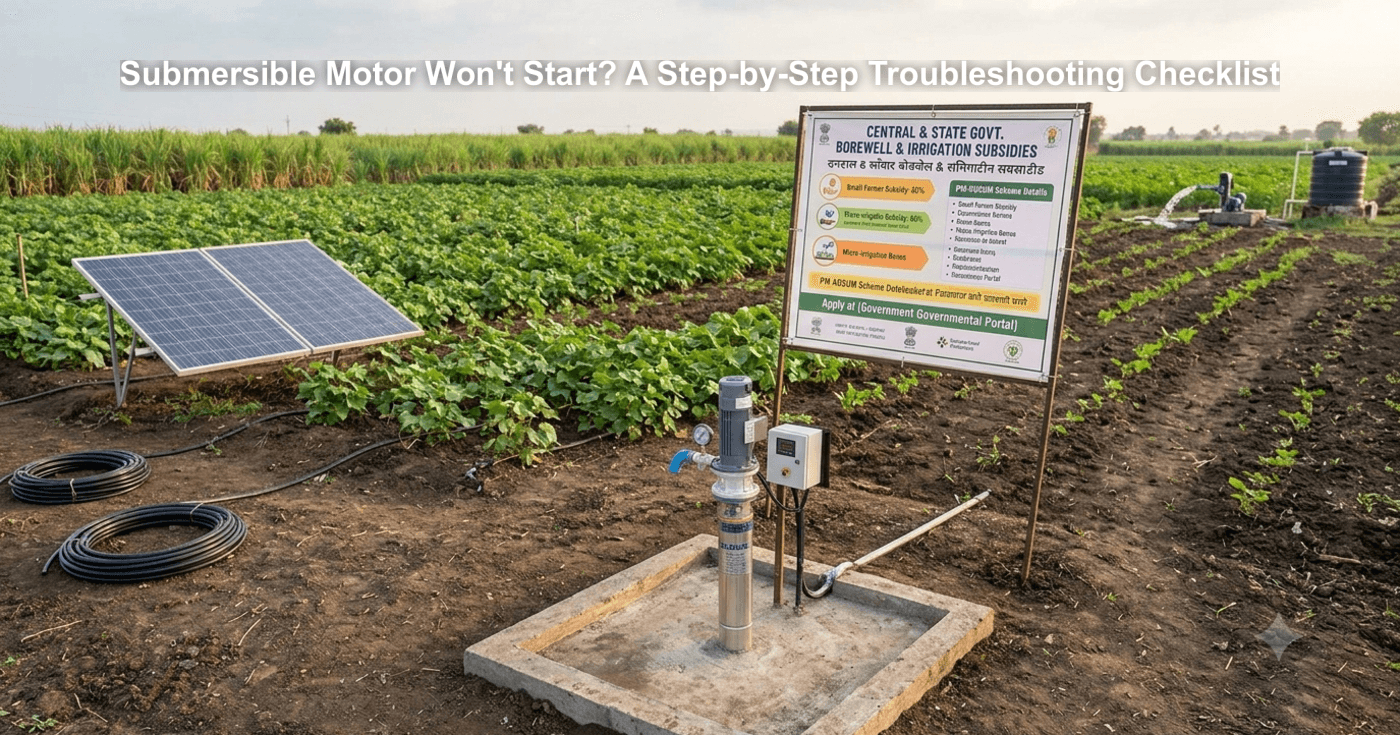
Submersible Motor Won't Start? Here's What to Check First
Few things disrupt a pumping installation more than arriving on-site to find the submersible motor won't start. Whether you're commissioning a new borewell system, responding to a service call, or conducting a routine inspection, a non-starting motor can stem from a surprisingly wide range of causes — from a tripped MCB to a damaged winding deep inside the pump assembly. The challenge is working through these causes systematically rather than guessing and replacing parts unnecessarily.
This checklist is written for electricians, pump installers, and service technicians working with single-phase and three-phase submersible pump systems in Indian agricultural and domestic water supply applications. At SLEKA Industries, we work closely with installers across the country and have compiled this guide based on real-world fault patterns reported from the field. Whether you're handling a 0.5 HP domestic unit or a 10 HP agricultural submersible, the diagnostic logic remains consistent.
Work through each section in sequence. Many faults are resolved within the first two or three steps, saving you the time and cost of pulling the pump out of the borewell unnecessarily. Always ensure power is isolated before performing any physical inspection or measurement.
Step 1: Verify the Power Supply and Control Panel
Before touching the motor or pump, confirm that the electrical supply side is functioning correctly. A large proportion of submersible motor won't start complaints are resolved here, without any intervention on the pump itself.
Check Incoming Voltage
Use a calibrated digital multimeter to measure the incoming supply voltage at the starter panel or control box.
- Single-phase systems: Supply should be 220–240V AC (±10%). Low voltage below 190V is a common culprit, especially during peak agricultural hours in rural feeders.
- Three-phase systems: All three phases should read 380–415V line-to-line. Check each phase-to-neutral as well.
- Action: If voltage is outside acceptable range, do not attempt to start the motor. Fit a voltage guard or wait for supply normalisation. Running a submersible motor on low voltage causes overheating and winding failure.
Check the MCB, Fuses, and Overload Relay
- Inspect the Miniature Circuit Breaker (MCB) or MCCB — confirm it is in the ON position and has not tripped.
- For three-phase panels, check all three fuses individually using a continuity tester. A single blown fuse on one phase will prevent a three-phase motor from starting and can cause single-phasing damage if overlooked.
- Check the thermal overload relay setting. It should be set to match the motor's full-load current (FLA) as printed on the nameplate. An incorrectly set overload relay set too low will trip the motor before it starts.
- Action: Reset tripped devices. If they trip again immediately on restart, a fault exists downstream — do not continue resetting.
Inspect the Starter and Control Wiring
- For DOL (Direct-On-Line) starters, verify the contactor is pulling in when the START button is pressed. Listen for the audible click and check the coil voltage.
- For star-delta starters used on larger motors, confirm the timer is functioning and the changeover from star to delta is occurring.
- Check all control wiring terminals for loose connections. Vibration over time causes terminals to work loose, especially in outdoor pump panels.
Step 2: Test the Motor Winding Resistance and Insulation
If power supply is confirmed normal and the motor still won't start, the next step is to test the motor windings themselves. This is done at the surface using the submersible cable tails.
Winding Continuity Test
Disconnect the motor cable from the panel. Using a multimeter set to resistance (Ω):
- Three-phase motors: Measure resistance across each pair of terminals: U-V, V-W, W-U. All three readings should be equal (or very close). A significant difference or an open circuit (OL/∞) on any pair indicates a broken or burnt winding.
- Single-phase motors: Measure across Main winding and Auxiliary (start) winding terminals. Compare readings to the motor specification sheet.
- Benchmark: Typical winding resistance for a 1–3 HP submersible motor ranges from 2Ω to 20Ω depending on design. Always compare all three phase readings to each other — imbalance matters more than absolute value.
Insulation Resistance (IR) Test
This is one of the most important tests for any submersible motor and is often skipped by less experienced technicians.
- Use a 500V Megger (insulation resistance tester) to measure resistance between each winding terminal and the motor earth/ground.
- Healthy motor: IR value should be above 1 MΩ — ideally 5 MΩ or higher for a recently commissioned motor.
- Below 1 MΩ: Indicates moisture ingress into the motor body or degraded winding insulation. The motor may need to be pulled from the borewell and dried or rewound.
- Reading near zero: Winding-to-earth short circuit. The motor requires rewinding or replacement.
- Record IR values over time. A steady decline across service visits is a reliable early warning of impending motor failure.
Step 3: Inspect the Capacitor (Single-Phase Motors Only)
For single-phase submersible motors, a faulty run or start capacitor is one of the most frequent causes of a submersible motor won't start scenario. The motor may hum audibly but fail to turn, or it may remain completely silent.
How to Test the Capacitor
- Discharge the capacitor safely before handling (short the terminals briefly with an insulated screwdriver).
- Use a digital multimeter with a capacitance (μF) measurement function. Compare the reading to the value printed on the capacitor body.
- A reading significantly below rated value (more than 10% lower) indicates a weak capacitor that should be replaced.
- A reading of zero or OL on capacitance mode indicates a dead capacitor.
- Visual check: Also inspect for any bulging on the capacitor top, which indicates internal failure.
- Replacement cost: A standard submersible pump capacitor in India typically costs ₹80–₹400 depending on μF rating and brand. Always replace with the exact rated value.
Step 4: Check the Submersible Cable Condition
The submersible cable runs from the surface panel down through the borewell to the motor — often 50 to 200 metres in depth. Cable faults are easy to overlook but are a significant source of starting failures and motor damage.
Surface Inspection
- Examine the cable at the wellhead entry point. This is the highest wear zone — check for cracking, kinking, or abrasion on the outer sheath.
- Inspect the cable joint where the panel cable joins the submersible cable. Poor jointing is a common installation fault. Joints must be fully waterproofed and mechanically secure.
Electrical Tests on the Cable
- With the motor disconnected at the pump end (if accessible), measure continuity on each conductor from surface.
- Measure insulation resistance from each conductor to earth. Cable IR should ideally exceed 10 MΩ. A lower reading suggests sheath damage and water tracking along the cable.
- A damaged submersible cable can cause intermittent starts, nuisance tripping, and ultimately motor winding failure due to voltage drops.
- Note: SLEKA Industries recommends using submersible-grade, flat three-core or four-core cable rated for continuous submersion, matched to the motor's FLA rating with appropriate derating for cable length.
Step 5: Physical and Mechanical Checks Before Pulling the Pump
If all electrical tests pass but the motor still won't start, or if the motor trips immediately on starting, a mechanical issue within the pump or motor assembly is likely.
Check for Pump Seizure
- A locked rotor condition — where the pump impeller or motor shaft is mechanically jammed — will cause the motor to draw very high current and immediately trip the overload.
- Causes include: sand ingress into the pump bowl, a collapsed bearing, or the pump running dry for extended periods causing seal damage.
- Test: If accessible, attempt to rotate the shaft manually. Any resistance or inability to rotate confirms seizure.
- Action: The pump assembly will need to be pulled from the borewell for mechanical inspection, disassembly, and repair.
Check the Motor for Sand Lock or Bearing Failure
- Sand-laden water is common in many Indian borehewells, particularly in alluvial zones. Fine sand particles can lock the motor rotor if the pump sits idle for extended periods.
- In some cases, running the motor briefly in reverse (on three-phase systems, swap any two phases) can dislodge sand lock — only attempt this on professional advice and never repeatedly.
- Bearing failure produces abnormal noise during starting attempts. Listen carefully with power applied for a short burst if safe to do so.
Conclusion: Diagnose Methodically, Repair Confidently
A systematic approach is the difference between a quick field fix and an expensive, unnecessary pump pull. When a submersible motor won't start, working through power supply, windings, capacitor, cable, and mechanical condition in that order gives you the highest probability of finding the fault quickly and economically.
Most faults — voltage issues, tripped overloads, failed capacitors, or poor cable joints — are resolved at the surface within 30 to 60 minutes with the right test equipment. Deep faults in windings or pump mechanics require the motor to come out, but your upfront testing will mean you arrive at that decision with confidence rather than guesswork.
For technically superior submersible pumps and motors built to perform reliably across Indian conditions, explore the full range at slekaind.com. SLEKA Industries designs and manufactures submersible pump systems engineered for longevity in demanding borewell environments — backed by service support and technical resources for installers and dealers across India.
Frequently Asked Questions
Q1: What is the most common reason a submersible motor won't start?
The most common causes are low or absent supply voltage, a tripped MCB or overload relay, or a failed run capacitor (on single-phase motors). Always check the electrical supply side first before testing the motor itself.
Q2: How do I know if my submersible motor winding is burnt?
Measure insulation resistance with a 500V Megger between each winding terminal and earth. A reading below 1 MΩ — or near zero — indicates damaged or shorted windings. Also check winding continuity; an open circuit on any winding phase confirms a burnt winding.
Q3: Can I restart a submersible motor that keeps tripping the overload relay?
Not without investigating the cause first. Repeated tripping indicates the motor is drawing excess current, which could be due to low voltage, a mechanical blockage, a failing winding, or a wrongly set overload relay. Continuing to reset without diagnosis risks permanent motor damage.
Q4: How often should I test insulation resistance on a submersible pump motor?
For motors in regular service, IR testing is recommended at every major service interval or annually — whichever comes first. In areas with high sand content or aggressive water chemistry, more frequent testing (every six months) helps catch insulation degradation early.
Q5: What cable size should I use for a 3 HP submersible motor?
Cable sizing depends on the motor's full-load current and the cable run length. For a 3 HP three-phase motor (approximately 4.5–5A FLA), a 3-core 1.5 sq mm submersible cable is typically adequate for runs up to 60–70 metres. For longer runs, upsize to 2.5 sq mm to limit voltage drop. Always consult the motor manufacturer's cable selection chart and use only submersible-rated flat cable.